
A practical, editable companion. Start with your own records, then compare the evidence with the guidance below.
A manufacturing quote is often the result of careful work. It may involve technical review, estimating, sales coordination, availability and pricing decisions. Yet after the proposal is sent, many teams struggle to see which opportunities are active and what should happen next.
Why a quote needs a next action
Not every open quote is lost, and not every quote requires repeated emails. Some customers are waiting for project funding or design approval. Others need a specification clarified or a revised delivery window. The objective is not pressure. It is relevant, timely communication based on a real buying process.
Seven questions for a quoting team
- Does each quote have a defined owner? An estimate that belongs to everyone often belongs to no one.
- Can you identify its current stage? Separate active, waiting, revised, won, lost and dormant opportunities.
- Is the follow-up appropriate to the buyer? An OEM engineer and a maintenance buyer may expect different information.
- Is customer feedback captured? Lead time, price, specifications and alternative sourcing should not disappear into a salesperson’s memory.
- Can the team find a complete history? Prevent disconnected inboxes, spreadsheets and CRM records from creating conflicting information.
- Does the sales promise match operational capacity? A faster reply matters less if the promised delivery cannot be met.
- What decisions does reporting support? Look at win rates, stale quote age and reasons for loss, not just number of estimates generated.
Improve the system without overbuilding it
The first answer may be consistent status definitions and a scheduled review. It may be a useful report from existing ERP or CRM data. It may require a modest workflow change or an outside integration specialist. Decide based on the actual gap and team capacity.
Our quote follow-up calculator models how an assumed change in win rate would affect contribution. It does not prove that follow-up alone will create the change. See more in Manufacturing and Industrial Business Consulting.
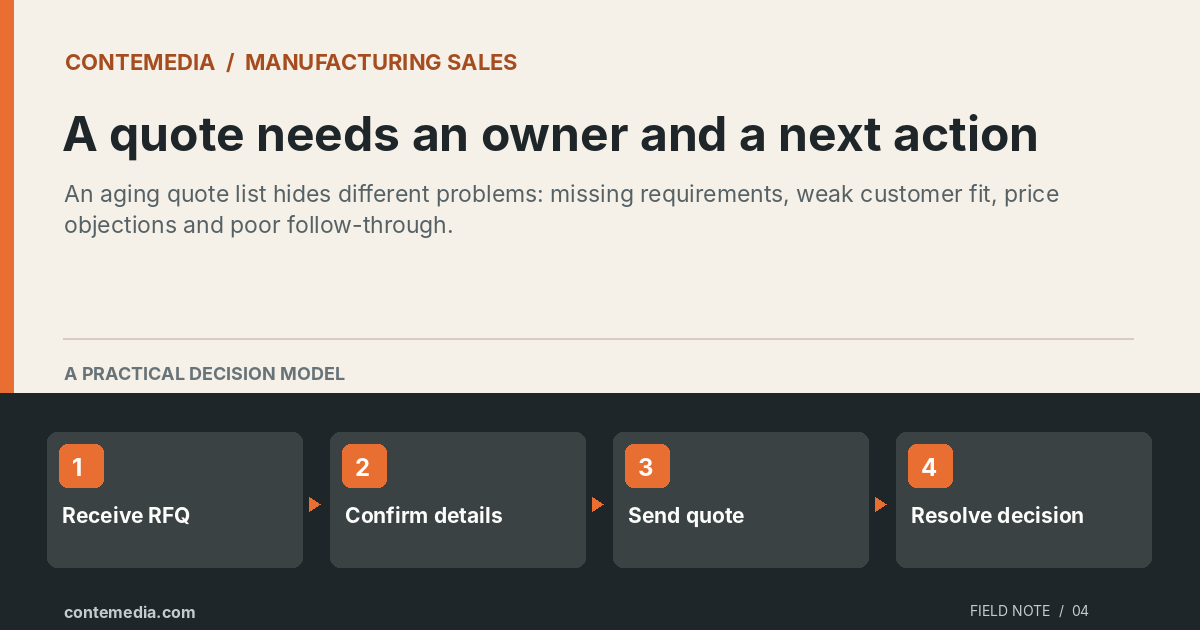
A quote needs an owner and a next action
An aging quote list hides different problems: missing requirements, weak customer fit, price objections and poor follow-through.
What to examine before changing the process
Before asking salespeople to chase every open quote, identify whether engineering information was complete, whether the buyer has a decision date, and whether the customer is still evaluating. A thoughtful follow-up adds information rather than merely asking for an update.
Illustrative case: 80 quotes were sent last month. Twenty show no next contact date; eight need engineering clarification; twelve are no longer active. Fixing the status rules first makes the actual opportunity visible and avoids overstating possible incremental orders.
Measure the change, not just the activity
Watch quote-to-order win rate by product and customer segment, quote age, first-response time, time waiting on technical information, reason lost and proportion with a dated next action.
Where the interpretation can go wrong
A win-rate change is not automatically caused by sales follow-up. Lead times, pricing, engineering scope, competition and customer timing also move the result.
Four checks before committing resources
- 01
Break quote age into stages: received, information needed, estimating, sent, technical review, waiting for buyer and closed. A single open status cannot explain which team can act next.
- 02
Sample lost bids and talk to the account owner. Price, fit, competitors, standard lead times and a customer project delay all mean different things for a next conversation.
- 03
A useful follow-up helps the buyer make a decision. It might provide a drawing, lead-time clarification, alternate specification or a reasonable quote expiration reminder. A repeated “checking in” email is not a substitute for value.
- 04
Protect the estimator from being judged only on wins when upstream inquiry quality is poor. Use consistent definitions for quote count, quote value, win rate and time to order before building a dashboard.