
CONTEMEDIA / PRACTICAL FIELD GUIDE
Manufacturers often have all the systems they need to quote a job, but still struggle to see where the opportunity went after the quote was sent.
The first improvement is visibility: who owns the quote, what information is missing and what the next action should be.
A practical, editable companion. Start with your own records, then compare the evidence with the guidance below.
of surveyed firms with 50 or more employees had adopted significant new technology over the prior two years.
NFIB technology adoption data is across industries and does not measure quote turnaround or manufacturing-specific outcomes. Read the original source.
Start with a complete inquiry
Missing specifications create back-and-forth. Agree on the minimum engineering, commercial and delivery details required before an estimate can begin.
Separate technical review from commercial follow-up
The estimator needs accurate requirements and cost assumptions. Sales needs to know whether the opportunity is active, delayed or closed. These are related responsibilities, not the same status.
Create visible status and ownership
Use a short list of statuses with one owner each. Avoid labels such as “pending” that do not identify whether the customer, engineering, purchasing or another function is holding the next action.
Measure the flow rather than just win rate
Track quote age, time to first response, completeness, revision count, next-action coverage and win or loss reasons. A win rate can be misleading if the mix or quality of opportunities changes.
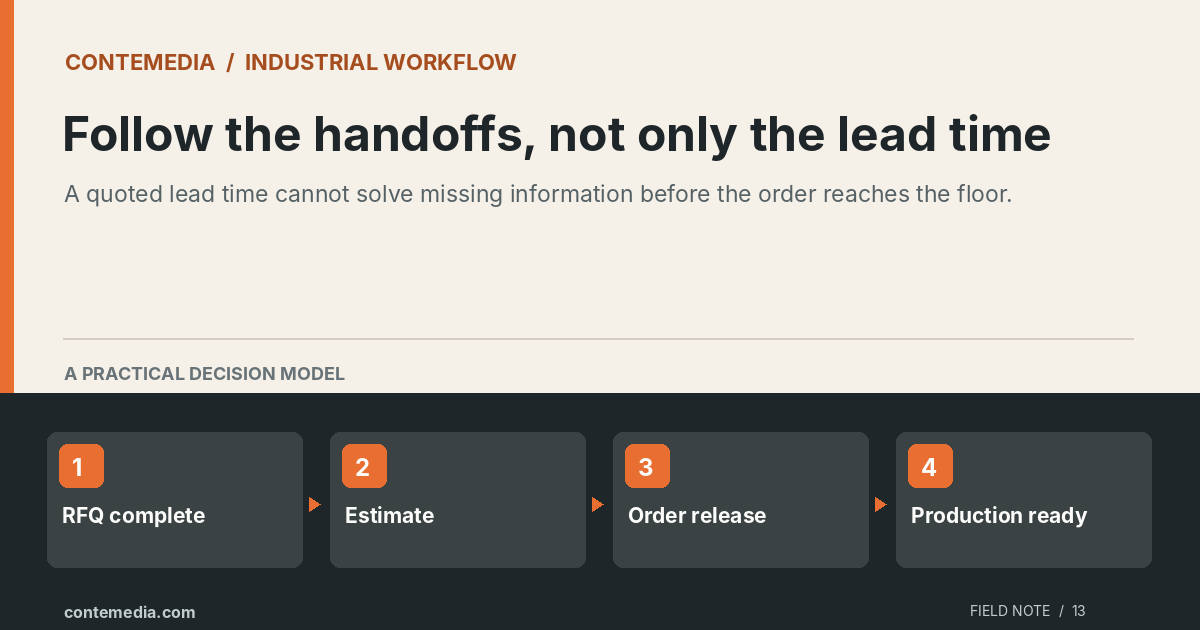
Follow the handoffs, not only the lead time
A quoted lead time cannot solve missing information before the order reaches the floor.
What to examine before changing the process
Industrial orders can pass through sales, engineering, estimating, order entry, purchasing, planning, production and shipping. Delays often accumulate at the transitions: missing specifications, unapproved drawings, uncertain dates, revised quantities or material availability.
Illustrative case: an eight-day quote-to-order interval includes one day of estimating and seven days waiting on customer clarification and internal approval. Buying faster estimating software cannot eliminate the seven-day queue. Assign each wait to an owner and decision.
Measure the change, not just the activity
Track time in each stage, rework loops, incomplete RFQ rate, order-entry corrections, engineering hold time, delivery-promise changes and on-time shipment for the agreed date.
Where the interpretation can go wrong
Do not mix a customer-approved hold with an internal processing delay. Both matter, but the corrective action is different.
Four checks before committing resources
- 01
Follow a small set of actual jobs across departments rather than asking each manager to describe an ideal process. Record timestamps, information requirements and the owner at each handoff.
- 02
Separate technical review, customer approval and scheduling waits. A single lead time number conceals the difference between work the business can improve and a decision the customer has not made.
- 03
Identify the point where the specification becomes controlled. Late drawing revisions, configuration errors and manually copied line items can cause expensive rework even when the original quote was timely.
- 04
A dashboard is only useful if stages mean the same thing to sales, estimating, planning and production. Agree on definitions and exception handling before automating status reports.
Compare the approaches
| Approach or step | What to consider |
|---|---|
| Intake | Requirements complete and contact identified |
| Estimate | Technical exceptions and price assumptions reviewed |
| Sent | Customer receives a clear proposal and next step |
| Follow-up | Owner, date, reason and outcome recorded |
Remove one avoidable handoff delay
- Audit ten recent quotes from different statuses.
- Write down missing data and every wait point.
- Assign one owner for next action on open quotes.
- Track revisions and quote age for thirty days.
- Test a targeted improvement before replacing software.
Frequently asked questions
Does a CRM solve quote delays?
Not alone. The input requirements, ownership and actual technical work must be defined first.
Should every quote receive the same follow-up?
No. Prioritize by fit, customer timing, commercial significance and the next action agreed with the buyer.
External data and additional reading
NFIB Small Business and Technology, 2025: Original source and methodology. Figures describe the source population and date, not Contemedia client results. Decisions and illustrative calculations must be validated with your own information.