
CONTEMEDIA / PRACTICAL FIELD GUIDE
A topical map earns its value when it helps a real visitor move from a question to an informed business decision.
Do not publish 100 interchangeable articles just to reach an output target. Build a smaller set of strong resources, then expand based on actual user questions.
A practical, editable companion. Start with your own records, then compare the evidence with the guidance below.
of surveyed NFIB small firms reported having a website.
NFIB surveyed 521 businesses in 2025. Website adoption does not measure SEO rankings, traffic growth or content quality. Read the original source.
Start with what the business knows
Identify your audiences, decisions and evidence. A manufacturing article should acknowledge technical buyers and quote handoffs. An ecommerce article should show margin calculations. Avoid publishing a generic definition when you can help someone do the work.
Rewrite existing pages before filling a calendar
Fix weak landing pages, inconsistent navigation, missing citations, broken links and thin tool explanations. Improve the route from high-intent queries to one useful next step.
Connect articles to tools
An article on lead follow-up should link to an editable calculator. A page about internal vs external teams should link to the staffing decision model, not a generic contact form on every paragraph.
Measure usefulness, not only clicks
Check organic impressions, search queries, internal tool usage, assisted conversions and qualitative questions from visitors. Revisit articles when data changes or the page does not satisfy the reader intent.
WORKING EXAMPLE / SEARCH STRATEGY
What a useful topical map actually looks like
Start with a business decision, not a keyword export. Consider a manufacturer selling configurable industrial components. A buyer may first need to understand a product, then compare specifications, then decide whether the supplier can make and deliver the part. Those are three different search tasks. One very long article is unlikely to be the best answer to all three, and several near-identical articles will only confuse the site structure.
Instead, create a clear primary guide for the main buying decision, supporting explanations for its harder questions, a usable specification or quote checklist, and a route to request help. The links should show the buyer how the answers fit together. Internal linking is not simply distributing authority between URLs. It is making the next useful piece of evidence easy to find.
| Visitor question | Best resource | Evidence to provide | Useful next step |
|---|---|---|---|
| Which product fits this application? | Product selection guide | Technical differences, constraints and examples | Compare specifications |
| What information does the supplier need? | Focused RFQ preparation guide | Dimensions, materials and required application data | Download the quote checklist |
| What changes delivery expectations? | Lead-time explanation | Standard versus custom requirements and known limitations | Submit a complete inquiry |
| What happens after the quote? | Quote-to-order workflow guide | Approval and handoff stages | Review the process |
Prioritize topics using business evidence
Customer service logs, conversations with sales, internal search terms, Search Console data, product questions and even rejected quotes can identify needs that keyword software misses. Record the exact question, the visitor's likely stage, what proof exists, the potential business value, and whether an existing page already answers it. If the evidence is weak, interview the people who hear the question instead of inventing content based only on a search-volume estimate.
Consider a second cluster for ecommerce. The visitor may ask why shipping is expensive, whether a product is suitable, how sizing works, or when an order will arrive. Each question implies a different format: a short sizing guide, a comparison, a delivery explanation or an interactive calculator. Content architecture should adapt to the job rather than forcing every query into the same article template.
Give internal links a job
A strong article link is where the reader needs it. When explaining how quote bottlenecks affect customer experience, link to the quote follow-up guide near that explanation. When the argument turns to economics, link to a calculator with defined assumptions. When the reader has moved from learning to making a consequential choice, link to the appropriate service page without using an intrusive sales prompt every few paragraphs.
Build a map that shows which page is the primary answer, which pages support it, and which tools or services turn learning into action. Then check the navigation in both directions. A supporting post should link back to its primary guide; a primary guide should selectively link to deeper explanations. Important pages should not be left as isolated search landings with no path into the rest of the site.
Refresh what is already published
Before producing more articles, audit the existing library for duplication, outdated examples, orphaned posts, misleading claims, broken downloads, thin sections and pages that fail to answer the promised question. A page that already earns qualified attention may be a better investment than a new article. Retain its useful URL where possible, improve its proof and structure, and update related pages to point to the improved resource.
Use an editorial review checklist that tests usefulness, originality, sources, internal navigation, readability, mobile layout, images and calls to action. A visually striking chart without explanatory value should not survive simply because it fills space. A worksheet should contain a real working method, not a blank branded sheet. And a social-preview image should help a reader understand or remember the idea while functioning correctly when the article URL is shared.
For measurement, look beyond ranking positions. Track which relevant queries the site serves, whether the visitor reaches the next question, whether a tool is used, and whether the resulting inquiries fit the business. Use those outcomes to decide what deserves expansion, consolidation or removal. The purpose of a topical map is not to justify publishing 100 articles. It is to build a useful body of expertise that can grow intelligently.
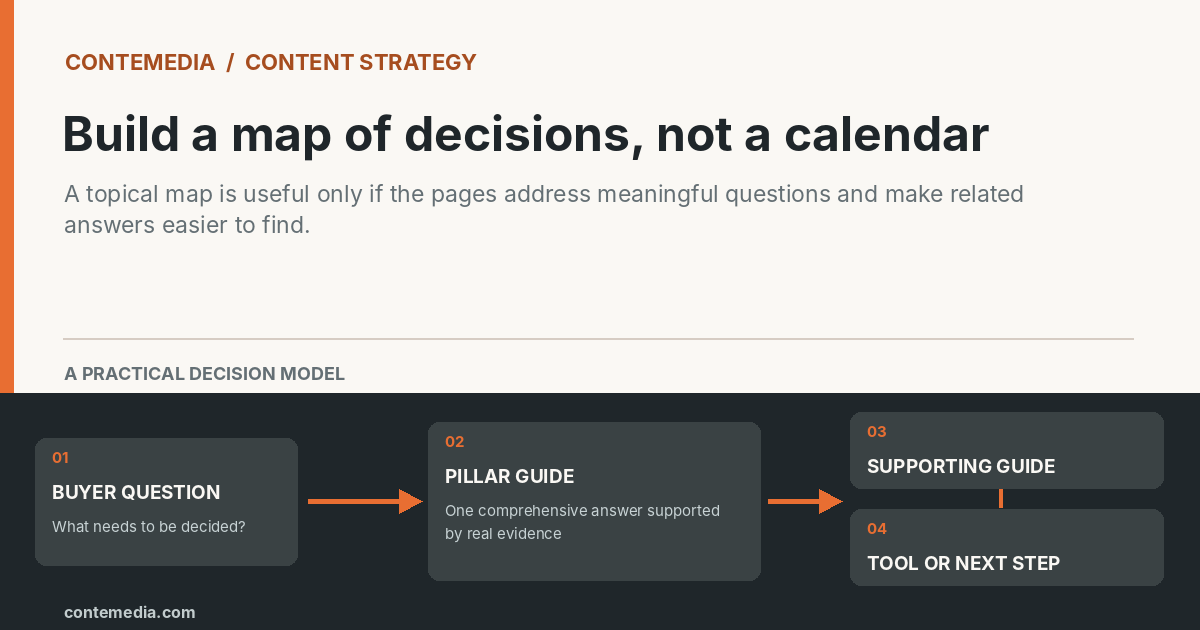
Build a map of decisions, not a calendar
A topical map is useful only if the pages address meaningful questions and make related answers easier to find.
What to examine before changing the process
Start with sales calls, search queries, site search, customer service questions and the situations where prospects hesitate. Group questions by the decision they support, not only keyword similarity. A pillar should offer a comprehensive answer while supporting guides explain distinct narrower choices.
Illustrative example: a manufacturer hears “How fast can you ship?” “What information is required for a quote?” and “What changes the lead time?” These questions form a purchase-readiness cluster with a technical guide, an RFQ checklist, a lead-time page, and an inquiry action. Publishing four generic “best manufacturing tips” posts would do less to help that buyer.
Measure the change, not just the activity
Review nonbranded query coverage, qualified organic visits, engaged navigation between relevant guides, downloads used, inquiries assisted, and broken or orphan internal links.
Where the interpretation can go wrong
Do not promise rankings from publishing frequency, word count or schema. A topic map is a plan to serve user needs, not a ranking guarantee.
Four checks before committing resources
- 01
Map questions to a real customer journey. The same keyword can signal very different intentions: early research, product evaluation, troubleshooting or a decision to contact a provider. Do not use search volume alone to decide which page deserves investment.
- 02
Audit existing coverage before commissioning new articles. A good page buried under vague navigation, duplicated headings and missing internal links may deserve revision more urgently than a new supporting article.
- 03
Use a hub-and-spoke structure with genuinely distinct pages. Every supporting guide should answer a focused question, reference a relevant primary guide, and lead toward evidence or a usable action. Do not create near-duplicate pages simply to capture wording variants.
- 04
Measure whether the library helps buyers progress. Review Search Console query coverage, passage usefulness, engagement with calculators and resources, inquiry quality, broken links and pages with no incoming internal links. Revisit the map as customer questions change.
Compare the approaches
| Approach or step | What to consider |
|---|---|
| Pillar guide | Explains the core decision comprehensively |
| Supporting article | Answers a narrower follow-up question |
| Free tool | Lets a reader apply their own numbers |
| Service page | Explains help available when the work is more complex |
Build a decision-led editorial map
- Define five topic clusters with distinct business questions.
- Audit existing pages and broken internal links.
- Publish high-confidence guides with sources.
- Link each guide to a relevant tool or next decision.
- Review search performance and page usefulness weekly.
Frequently asked questions
Do I need 100 articles to rank?
No. Search visibility depends on relevance, quality, competition and many other factors. Article count is a planning device, not a ranking promise.
Should I remove dates from articles?
A timeless interface can omit displayed dates while preserving accurate publication and update metadata where needed.
External data and additional reading
NFIB Small Business and Technology, 2025: Original source and methodology. Figures describe the source population and date, not Contemedia client results. Decisions and illustrative calculations must be validated with your own information.