
CONTEMEDIA / PRACTICAL FIELD GUIDE
An AI agent is not a shortcut to a well-run business. It is a way to carry out a defined workflow across information and tools, within permissions you control.
A useful agent has a narrow job, a clear source of truth, permission boundaries, a fallback path and a measurable reason to exist.
A practical, editable companion. Start with your own records, then compare the evidence with the guidance below.
of surveyed U.S. small employer firms reported using AI in their business or through employees.
This survey measures general AI use, not adoption of autonomous agents. Respondents were drawn from a nationwide convenience sample of employer firms. Read the original source.
Start with one workflow, not a job title
Inventory tasks that repeat, require predictable information and currently cause delays. An agent that retrieves order status, drafts a follow-up, or classifies a request is more practical to pilot than an agent asked to “run customer service.” Give it a trigger, the systems it may read, outputs to produce and a named person responsible for exceptions.
Specify what it is allowed to do
Read-only access is a different risk from changing a CRM record, issuing a refund or contacting a customer. Put approvals before external communication and irreversible actions. Record the inputs, tool actions and result so a supervisor can investigate mistakes.
Measure the full cost
Count licenses, implementation, oversight, corrections, security review and staff training. Time saved is capacity recovered, not necessarily a reduction in payroll. Compare the agent against a simpler rule-based automation and against fixing the existing process.
Pilot, inspect and decide
Use a small set of real but properly handled cases, track failure types, and let frontline employees challenge the design. Expand only when the workflow saves meaningful effort without worsening customer experience.
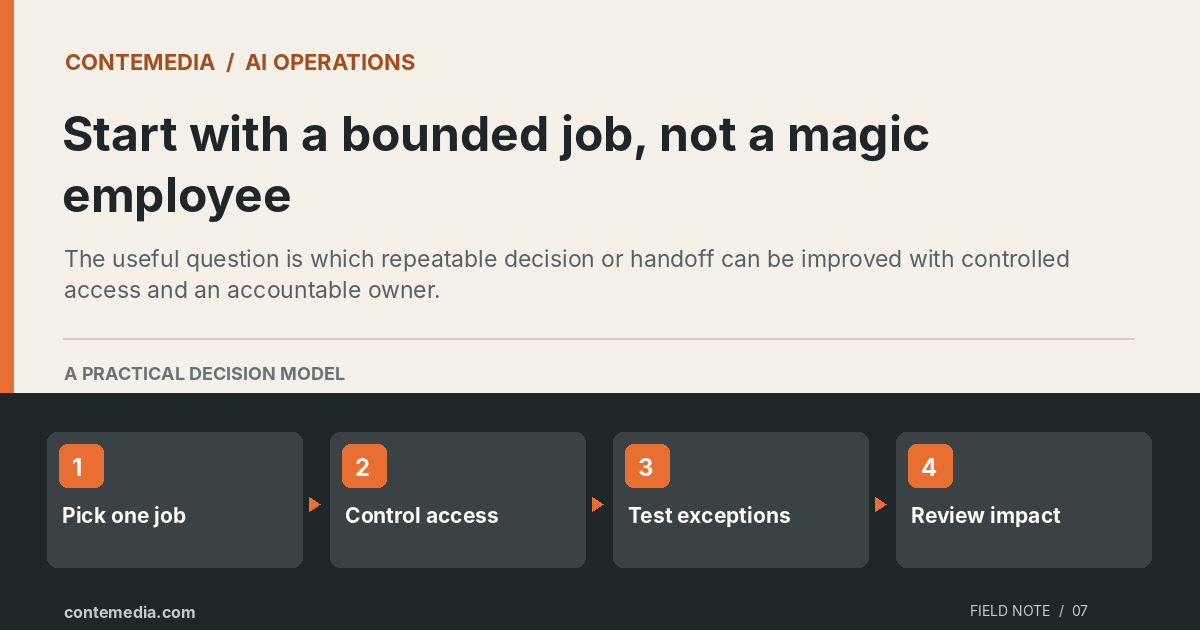
Start with a bounded job, not a magic employee
The useful question is which repeatable decision or handoff can be improved with controlled access and an accountable owner.
What to examine before changing the process
Separate simple assistants that draft and suggest from automations that follow fixed rules and agents that select actions. A higher-autonomy system adds tool permissions, error handling, review requirements and ongoing upkeep. Use the least complex approach that achieves the need.
Illustrative case: staff spend six hours weekly copying public order-status details into draft email responses. A read-only assistant with staff review could be tested before granting permission to send mail or change the order system. The pilot should count verified minutes saved after corrections and oversight.
Measure the change, not just the activity
Track accepted outputs, correction rate, exceptions escalated, time to complete, human review minutes, security incidents and customer outcomes.
Where the interpretation can go wrong
Avoid valuing time saved as guaranteed cash savings. Also avoid granting broader system access simply to avoid building a reliable handoff.
Four checks before committing resources
- 01
Map one workflow from trigger through output, including where the authoritative facts live. An agent needs access to the right information and a rule for admitting it does not know the answer.
- 02
Choose the minimum autonomy needed. Retrieval and drafting with human approval may deliver most of the value of a fully connected agent while avoiding the risk of unattended system changes.
- 03
Test wrong IDs, stale records, inaccessible sources and adversarial instructions. Count the cost of human review and correction so the business case reflects actual operating conditions.
- 04
Name the system owner before the pilot and define what the employee does when the AI fails. A tool with no accountable person or maintenance plan cannot be treated as a finished business process.
Compare the approaches
| Approach or step | What to consider |
|---|---|
| Assistants | Draft and explain; user remains the operator |
| Automations | Execute predefined steps when rules match |
| Agents | Choose permitted next actions within a bounded workflow |
| Human owners | Authorize sensitive actions and handle exceptions |
Pilot one small, controlled workflow
- Choose one repeated task with a known owner.
- Document the authoritative data source and what may not be accessed.
- Define how failed or ambiguous cases reach a person.
- Test accuracy, resolution time, staff corrections and customer impact.
- Record a decision to scale, revise or stop.
Frequently asked questions
Can an AI agent replace a person?
Some tasks may be automated, but accountability, exceptions and approvals still need people. Do not treat headcount changes as an automatic result.
What is a good first project?
A low-risk, frequent task with clean source information and a human checkpoint.
External data and additional reading
Federal Reserve Small Business Credit Survey, 2026: Original source and methodology. Figures describe the source population and date, not Contemedia client results. Decisions and illustrative calculations must be validated with your own information.