
A practical, editable companion. Start with your own records, then compare the evidence with the guidance below.
The sales number that appears in an order dashboard is not the amount a business keeps. To compare channels meaningfully, include the fees each channel charges, your product and fulfillment costs, advertising, and the cost of returns.
Professional seller subscription per month before referral and optional program fees.
Transaction fee on the total order amount, separate from listing and processing charges.
Different fee structures produce different economics
Amazon’s referral fee can vary by category and item price. eBay adds a per-order amount and may use a fee base that includes shipping and sales tax. Etsy combines a listing, transaction and payment processing fee. Shopify’s card rates and plan costs are different again, and your own shop must generate its own traffic.
Do not assume that the channel with the lowest fees is the most profitable. Lower acquisition costs, stronger discovery, more repeat customers and labor requirements can outweigh the fee line.
Compare the costs of your own product ↗
External data sources: Amazon · eBay · Etsy · Shopify. Read each platform’s current terms for your exact category and plan.
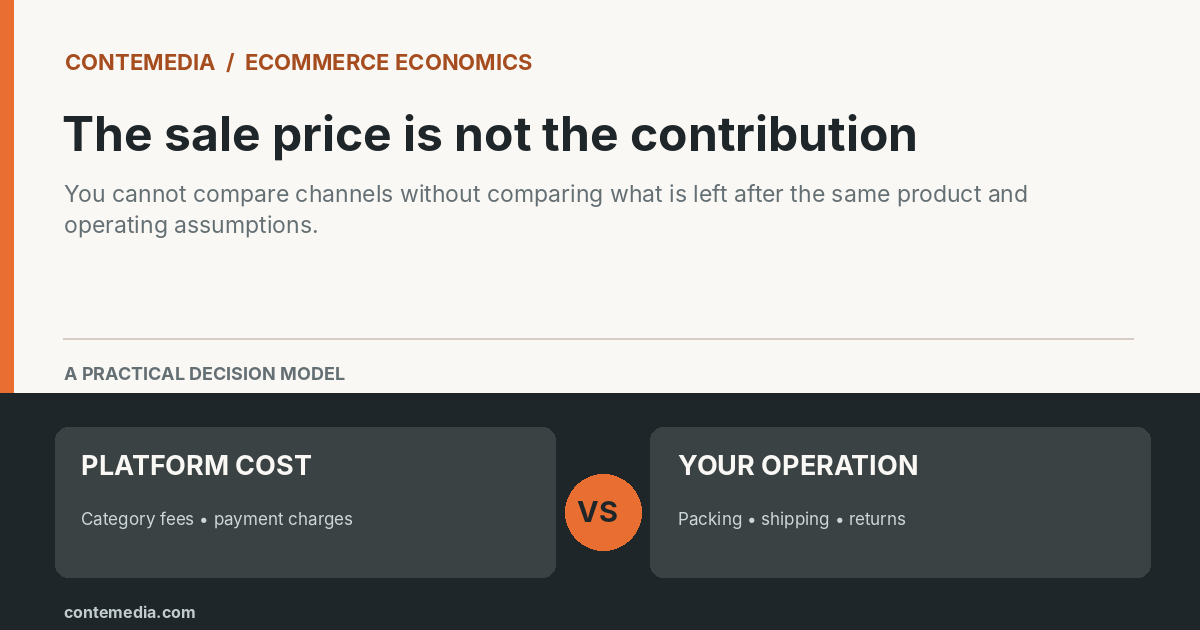
The sale price is not the contribution
You cannot compare channels without comparing what is left after the same product and operating assumptions.
What to examine before changing the process
Different marketplaces calculate fees on different bases, sometimes including shipping and tax amounts. Some fees vary by category, service level or seller plan. Confirm the current schedule for your SKU rather than using a generic percentage found in an article.
Illustrative scenario: an item sells for $30, costs $9, and needs $5 in delivery and packing. If combined platform and payment fees are $4.20, contribution before advertising, returns, and fixed overhead is $11.80. Another channel with a lower fee can still perform worse if it costs more to acquire the buyer.
Measure the change, not just the activity
Use per-order contribution, acquisition cost, return rate, repeat purchase value, pick-pack time and net settlement reconciliation, not gross sales volume alone.
Where the interpretation can go wrong
Do not count ad spend twice, mix cash received with recognized revenue, or compare different shipping promises as though they are equivalent.
Four checks before committing resources
- 01
Collect platform statements and order-level export files, not just fee tables. Identify exactly what each fee was charged against and whether subscriptions, refunds or adjustments are applied at the transaction or account level.
- 02
Reconcile one order end to end: buyer payment, platform charges, sales tax treatment, shipping label, product cost and any advertising attribution. Differences between paid amount and payout are normal, but they must be explainable.
- 03
Compare different channels on equal service promises. A marketplace may charge more but deliver valuable discovery; a branded store can be cheaper per transaction but require acquisition spending, fraud prevention and additional customer support.
- 04
Create a fee-assumptions ledger with date, source and category. Check it when prices change, when platform terms change, or when the seller adds a new fulfillment service. This prevents an old estimate from turning into a false margin.