
A practical, editable companion. Start with your own records, then compare the evidence with the guidance below.
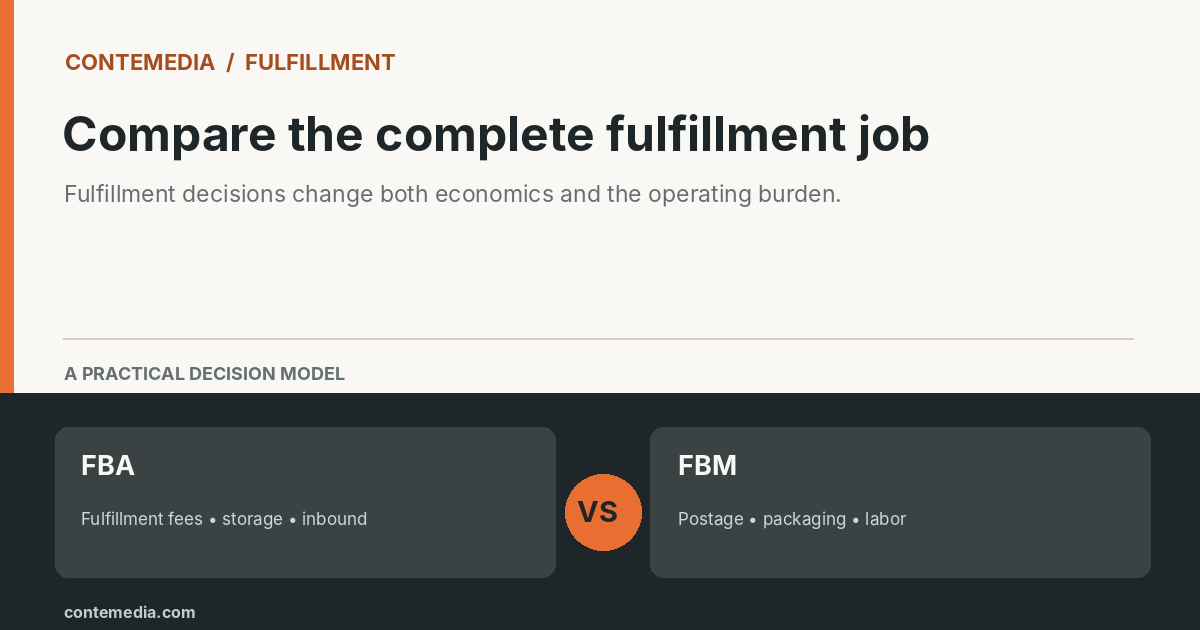
FBA and FBM answer a different question from whether your product belongs on Amazon. You still pay the platform’s selling fees, but the cost of packing, shipping, storage, customer service and returns shifts depending on the method you choose.
What to compare
Amazon FBA
Fulfillment fee based on product characteristics, storage, preparation, inbound costs, aged inventory risks and available customer delivery features.
Seller-fulfilled (FBM)
Shipping labels, materials, staff time, storage, dispatch consistency, return handling and the level of service your team can provide.
Why a generic FBA fee calculator can be misleading
A small lightweight item and a bulky product are not charged alike. Start with Amazon’s official SKU-specific Revenue Calculator and enter the number for your item. Then run your own FBM figures alongside it.
Compare your FBA and FBM scenarios ↗ · Official Amazon fee guidance ↗
Compare the complete fulfillment job
Fulfillment decisions change both economics and the operating burden.
What to examine before changing the process
FBA fees depend on size, weight, category and storage conditions. FBM involves labels, labor, packaging, service standards and returns. A fair comparison uses the same sales assumptions and includes cash tied up in inbound inventory.
Illustrative scenario: an item generates $14 contribution before fulfillment. FBA costs $5.60 per unit including an allocation for inbound and storage, leaving $8.40. FBM costs $4.90 in postage, packaging and staff time, leaving $9.10. The 70-cent difference may reverse if late dispatch or storage congestion changes either case.
Measure the change, not just the activity
Review contribution per unit, days of cover, storage age, dispatch consistency, return handling time and inventory accuracy.
Where the interpretation can go wrong
Do not assume Prime eligibility guarantees more orders, or that staff time costs zero when the owner personally packs.
Four checks before committing resources
- 01
Pull Amazon fee estimates for the actual ASIN or SKU and confirm dimensional weight, preparation, inbound placement, current storage and any long-term storage exposure. A single published table cannot reflect every item.
- 02
For FBM, time a normal order at the working pace of the team, including printing the label, picking, packing, customer inquiries and returns. Consider who covers fulfillment when the owner is away.
- 03
Model service levels as well as cost. Customer expectations, listing eligibility, return routing, delivery defects and inventory placement affect the practical choice, even when a spreadsheet shows one route is slightly cheaper.
- 04
Review inventory risk separately: units held at Amazon and units held locally may have different availability and cash-flow consequences. A mixed strategy can make sense for some products and seasons, but it also adds tracking complexity.