
CONTEMEDIA / PRACTICAL FIELD GUIDE
A score can organize a conversation, but it cannot replace evidence or the experience of the people doing the work.
Treat the Contemedia score as a self-assessment and investigation map, not a percentile ranking or verified industry benchmark.
A practical, editable companion. Start with your own records, then compare the evidence with the guidance below.
of surveyed NFIB firms reported introducing significantly improved or new technology in the previous two years.
Technology adoption is background context, not evidence that any particular business health score predicts outcomes. Read the original source.
Read coverage before the score
A 78 calculated from seven answers is not the same evidence as a 78 calculated from twenty-one. Skip and N/A options protect accuracy when a question does not apply, but the report must show how much of the assessment was completed.
Look for patterns instead of a pass mark
If customer response is strong but handoffs are weak, the next action may be to map who owns a qualified inquiry after the first reply. If reporting looks weak, first confirm whether the data itself is unreliable or simply hard to see.
Compare roles without blaming employees
Owners, supervisors and operators may view the same process differently. That difference is useful evidence. Ask for a recent example and walk the actual transaction from start to finish before assigning a score to anyone.
Turn one finding into a test
Choose a metric, a named owner, a baseline and a short review window. A self-rating can suggest where to look; the observed result should determine whether to continue.
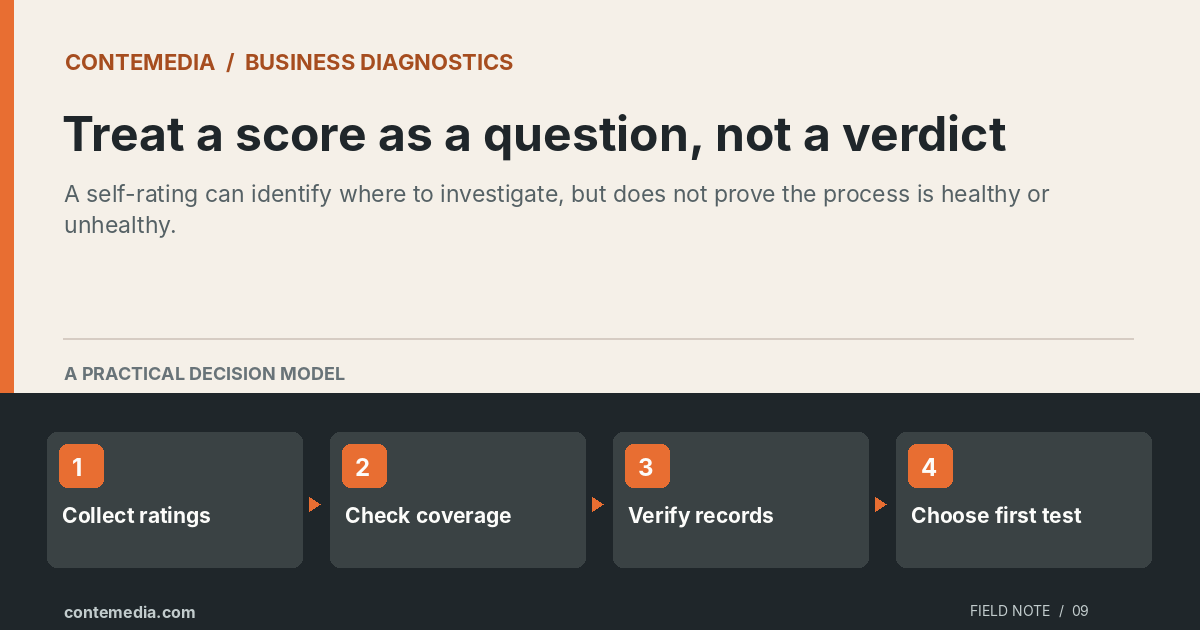
Treat a score as a question, not a verdict
A self-rating can identify where to investigate, but does not prove the process is healthy or unhealthy.
What to examine before changing the process
One person may rate reporting highly because the dashboards look good while the operator knows data is two days old. Compare perspectives, mark genuinely inapplicable areas, and examine the actual transaction or outcome before recommending an investment.
Illustrative case: a team rates customer response 4 out of 5 but a call-log review shows that 14 of 60 legitimate inquiries lacked an owner. The disagreement is valuable evidence. It does not mean the numerical assessment is fraudulent; it means the review needs another source.
Measure the change, not just the activity
Look at area coverage, agreement between respondents, age of supporting records, named process ownership and the verified impact of the first corrective action.
Where the interpretation can go wrong
Do not convert a proprietary self-rating into an industry percentile or present a change in the score as proven financial improvement.
Four checks before committing resources
- 01
Inspect the denominator and the coverage before studying the headline index. An unanswered or inapplicable area must not quietly lower a score or be presented as proof the business has a weakness.
- 02
Compare the owner rating against someone who performs the work. A disagreement can point to a reporting blind spot, an undocumented workaround or a process that only works when a particular employee is present.
- 03
Choose evidence that directly relates to the low-rated practice: lead response records, quote ages, supplier delays, fulfillment errors, gross margin or incident trends. General revenue growth alone cannot verify a particular workflow.
- 04
Record what changed, when it changed and who owns the result. Repeating a survey may reveal different perception, but only an operational measure can tell whether the intervention improved the work.
Compare the approaches
| Approach or step | What to consider |
|---|---|
| Score | Self-rating translated to a 0–100 discussion index |
| Coverage | Share of eligible questions answered |
| N/A | Excluded because the question is not relevant |
| Skipped | Not scored; report shows missing evidence |
Validate the evidence behind the ratings
- Review which sections were excluded and why.
- Identify the two lowest applicable domains.
- Ask for one concrete example in each domain.
- Assign one observable measure and responsible person.
- Repeat the review after the process changes.
Frequently asked questions
Is 80 a good score?
There is no validated external cutoff. Look at coverage, relative strengths, evidence and the decision you intend to make.
Should employees see each other’s ratings?
Share only with a clear purpose and appropriate consent; emphasize process learning, not grading individuals.
Download field-ready worksheets
Use these downloadable, formatted Excel worksheets to capture observations and assign follow-up. They are templates, not data collected or stored by Contemedia.
Download the branded nine-tab Excel field kit, or explore the individual worksheets in our resource library.
External data and additional reading
NFIB Small Business and Technology, 2025: Original source and methodology. Figures describe the source population and date, not Contemedia client results. Decisions and illustrative calculations must be validated with your own information.