
CONTEMEDIA / PRACTICAL FIELD GUIDE
The fulfillment decision changes as order volume affects labor scheduling, storage pressure, packing time and fixed costs. It does not change the fee on an individual item by magic.
Use 1, 10, 100 or 1,000 orders a day as hypothetical scenarios and insert your own SKU economics.
A practical, editable companion. Start with your own records, then compare the evidence with the guidance below.
Amazon Professional seller plan monthly fee, excluding referral and other optional fees.
Amazon US published plan price. This does not include SKU-specific FBA fees, advertising, inbound costs, storage or merchant shipping. Read the original source.
Separate common from method-specific costs
The same selling price, referral fee, advertising allowance and product cost generally belong on both sides of the comparison. Only then compare FBA fulfillment, inbound handling, storage and preparation against merchant shipping, packaging, labor, overhead and return handling.
Model a per-unit case first
Use Amazon’s Revenue Calculator for an actual product weight, dimensions, category and price. Do not treat the sample fee in a third-party calculator as the platform quote.
Scale the right costs with volume
A per-order difference of $1 produces $300 over a 300-unit month and $3,000 over a 3,000-unit month, before changes in capacity and fixed costs. These numbers are arithmetic examples, not sales predictions.
Consider constraints beyond cost
FBA may change delivery experience and operational workload. FBM may preserve more control but needs reliable dispatch capacity. Inventory risk, cash flow, returns and seasonality matter as much as the unit comparison.
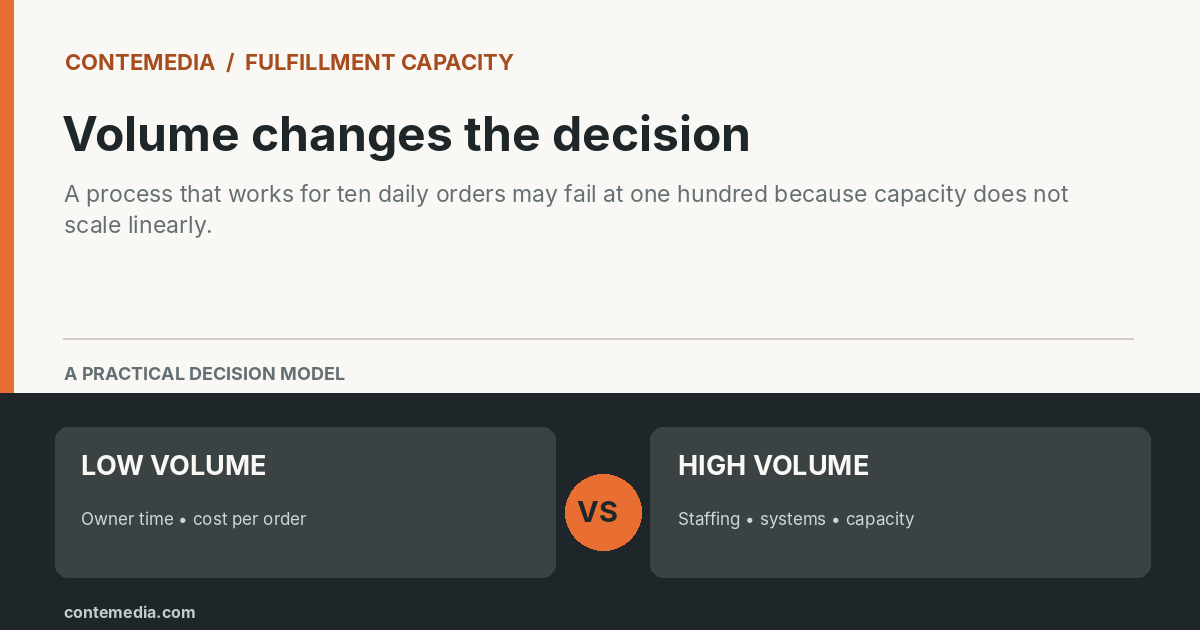
Volume changes the decision
A process that works for ten daily orders may fail at one hundred because capacity does not scale linearly.
What to examine before changing the process
At low volume, the owner may absorb packing work. At moderate volume, the schedule and carrier pickup matter. At high volume, staff shifts, storage, errors, packaging supplies and systems capacity change the cost curve. Use volume-specific costs rather than assuming a fixed labor rate per order.
Illustrative scenario: packing takes five minutes per order. At ten orders daily that is 50 minutes, but at 100 orders it is over eight hours of direct packing before interruptions, returns or rework. At 1,000 orders a day it is more than 83 labor hours and demands a completely different operation.
Measure the change, not just the activity
Model labor hours, parcel cost tiers, inbound receiving, error rate, storage and space utilization, working capital, and customer delivery consistency by scenario.
Where the interpretation can go wrong
Do not extrapolate a single order as if staffing, carriers and inventory were infinitely elastic.
Four checks before committing resources
- 01
At one or ten orders per day, confirm whether the business is absorbing unrecorded owner labor. That convenience disappears when volume rises or the owner is unavailable.
- 02
At one hundred daily orders, identify the operational bottleneck: packing stations, replenishment, carrier collection, inventory accuracy, customer support or returns. Each bottleneck has a different cost curve.
- 03
At one thousand daily orders, batch handling, staffing shifts, automation, facility space and exception management become central. A product-specific fee estimate is still necessary, but it is no longer the whole decision.
- 04
Use the threshold at which the process changes, not an arbitrary date, to reconsider fulfillment strategy. A hybrid arrangement can be useful when demand varies sharply across products or seasons.
Compare the approaches
| Approach or step | What to consider |
|---|---|
| 1 / day | About 30 monthly orders; learning and low-volume operations |
| 10 / day | About 300 monthly orders; repeatability and packing effort matter |
| 100 / day | About 3,000 monthly orders; staffing and capacity become central |
| 1,000 / day | About 30,000 monthly orders; inventory and systems deserve stress tests |
Stress-test your volume scenarios
- Choose an actual or plausible SKU.
- Record size, weight, selling price and product cost.
- Enter an Amazon SKU-specific fee quote.
- Time your own pick, pack and dispatch steps.
- Test multiple volumes and document the break-even assumptions.
Frequently asked questions
Does FBA always increase sales?
No. Any conversion or demand change must be modeled as a hypothesis, not a promise.
Can an FBM seller scale to high volume?
Yes, with appropriate shipping operations, staffing, systems and delivery commitments.
External data and additional reading
Amazon US Selling Plans and Pricing: Original source and methodology. Figures describe the source population and date, not Contemedia client results. Decisions and illustrative calculations must be validated with your own information.