
CONTEMEDIA / PRACTICAL FIELD GUIDE
A custom system can look attractive until it needs support, data migration, security updates and a long-term owner.
Before buying new software or commissioning a custom system, test whether a current tool can be configured to handle the job.
A practical, editable companion. Start with your own records, then compare the evidence with the guidance below.
of firms planning AI adoption cited finding or adapting tools as a challenge.
This reflects an optional AI-related survey question, not a general software procurement benchmark. Read the original source.
Describe the capability, not the vendor pitch
Write what information enters, what decisions occur, what output is needed, and who supports the result. A precise requirement reveals whether the feature already exists in a CRM, ERP or ecommerce platform.
Compare a real ownership horizon
A license can be more expensive over five years than it looks today. A custom build can require security patches, cloud hosting, developer availability, testing and documentation. Model the transition costs and what happens if the original supplier disappears.
Make integration risk visible
How does the new tool get authoritative customer, order and product data? Where do errors go? Can employees see which record is correct? Bad integrations often turn into spreadsheet workarounds.
Decide what makes the business distinctive
A capability that genuinely differentiates the business may justify custom development. Common accounting, email and routine scheduling requirements rarely need reinvention.
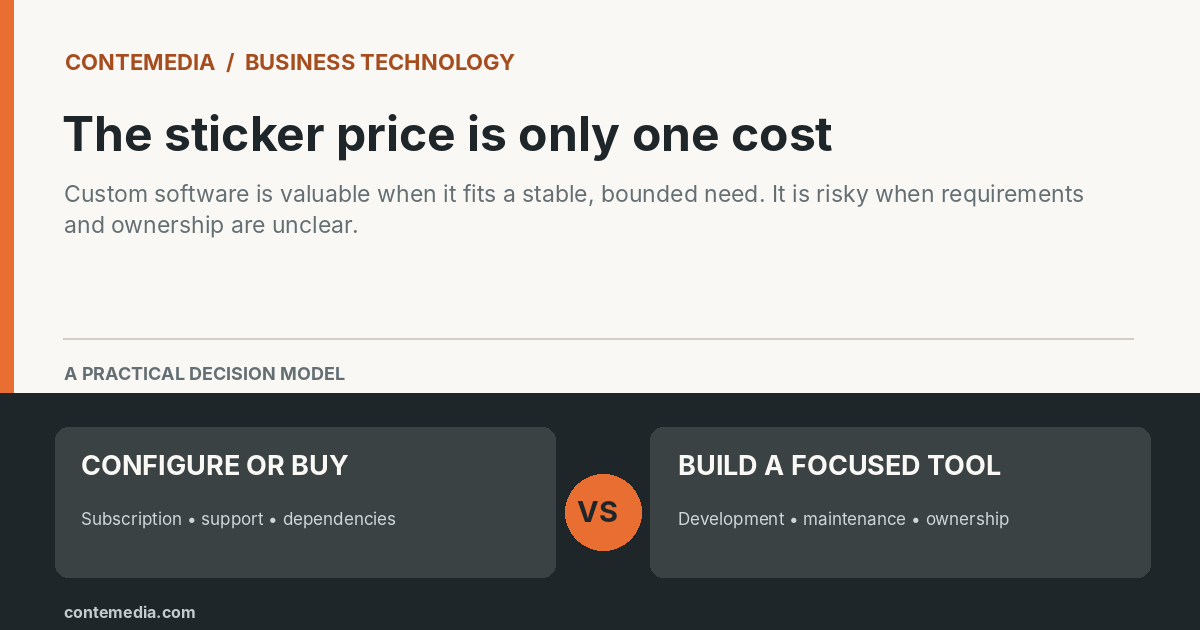
The sticker price is only one cost
Custom software is valuable when it fits a stable, bounded need. It is risky when requirements and ownership are unclear.
What to examine before changing the process
Off-the-shelf tools bring support and updates but can require expensive subscriptions, workarounds or unused features. A custom tool can solve a focused workflow but creates maintenance, security and documentation responsibilities. Compare configuration of tools already owned before paying to replace them.
Illustrative case: a company spends 0 per month on software but only needs two functions. A ,000 custom build would not automatically pay back in 12 months because hosting, maintenance, data migration, change control and integration support remain. Model at least three years and include the cost of switching back.
Measure the change, not just the activity
Compare total cost of ownership, implementation time, data portability, integration failures, staff adoption and business-critical downtime.
Where the interpretation can go wrong
Do not mistake a working prototype for a production system with backups, access controls, tests and accountable support.
Four checks before committing resources
- 01
List the required outcomes, not a giant requested feature list. Identify which tasks must be reliable on day one and which features could wait until users confirm that the base workflow solves the problem.
- 02
Investigate capabilities already licensed. Poor configuration, duplicated tools and missing training are common reasons a company pays for another platform without retiring the old one.
- 03
Model three years of ownership with implementation, maintenance, support, security, migration and vendor exit. Include the cost of repairing a custom tool after the original developer is unavailable.
- 04
Test the most failure-prone integration before choosing a direction. A good screen mockup does not prove the data flow, permission model, recovery mechanism or operational support will work.
Compare the approaches
| Approach or step | What to consider |
|---|---|
| Configure existing | Fastest when core capability is already included |
| Buy SaaS | Shared maintenance; recurring cost and vendor dependence |
| Commission custom | Tailored workflow; support, quality and continuity obligations |
| Hybrid integration | Combine tested systems with limited custom connectors |
Test the real ownership costs
- Map the minimum required workflow.
- Ask existing vendors what the current software can already do.
- Compare implementation, training, integration and maintenance.
- Test exportability, support ownership and exit risk.
- Run a 30-day pilot for a contained process.
Frequently asked questions
Is custom software always more flexible?
It may be easier to tailor initially, but evolving the code still requires budget, skills and testing.
What is the quickest way to reduce risk?
Pilot the smallest meaningful workflow against real tasks before migrating critical records.
External data and additional reading
Federal Reserve Small Business Credit Survey, 2026: Original source and methodology. Figures describe the source population and date, not Contemedia client results. Decisions and illustrative calculations must be validated with your own information.