
A practical, editable companion. Start with your own records, then compare the evidence with the guidance below.
When sales slow down, buying more traffic can feel like the obvious solution. But what if your business is already attracting potential customers and losing them between the inquiry and the conversation?
Lead generation and lead management are different jobs
Marketing helps make the right people aware of a business and gives them a reason to inquire. Lead management determines what happens next. One responsibility doesn’t replace the other. A beautiful service page or a strong advertising campaign cannot help an inquiry that never reaches a person who can respond.
Consider a service company that receives calls, forms and social messages. Calls are answered by whoever happens to be free. Website forms go to one inbox. Some social messages reach the owner personally. Even if the number of leads is healthy, the experience is inconsistent. The issue is not necessarily demand.
Start with five basic questions
- Where do inquiries arrive? Count each entry point, including phone, forms, email, marketplace requests and referrals.
- Who is responsible for each one? A shared inbox is not the same as a defined owner.
- What happens after the first attempt? Missed calls, unreturned voicemails and unanswered estimates need a rule.
- How do you know an opportunity was handled? Decide what constitutes a contacted lead, a qualified lead and a closed opportunity.
- Where does the process break down? Look at the actual timing and disposition of recent inquiries, not anecdotal impressions.
Why process comes before automation
Automation can route a request, remind a staff member or provide coverage after hours. But software needs a clear rule about who owns an inquiry and what should happen next. Otherwise, it simply moves confusion faster. A voice assistant can be useful for capturing a call, but someone still needs to review the request, follow through, and protect the customer’s experience.
Put a number on the opportunity without pretending it’s guaranteed
Use your current inquiry volume, close rate, customer revenue and contribution margin to create conservative scenarios. Don’t assume a single industry statistic applies to your business. Our free lead follow-up calculator shows the exact math and makes it easy to test different inputs.
If the data supports an opportunity, fix the handoff and measure the difference before increasing spend. A more reliable customer experience may be the highest-return marketing improvement available.
Related consulting: Marketing and Customer Growth and Business Process and Efficiency.
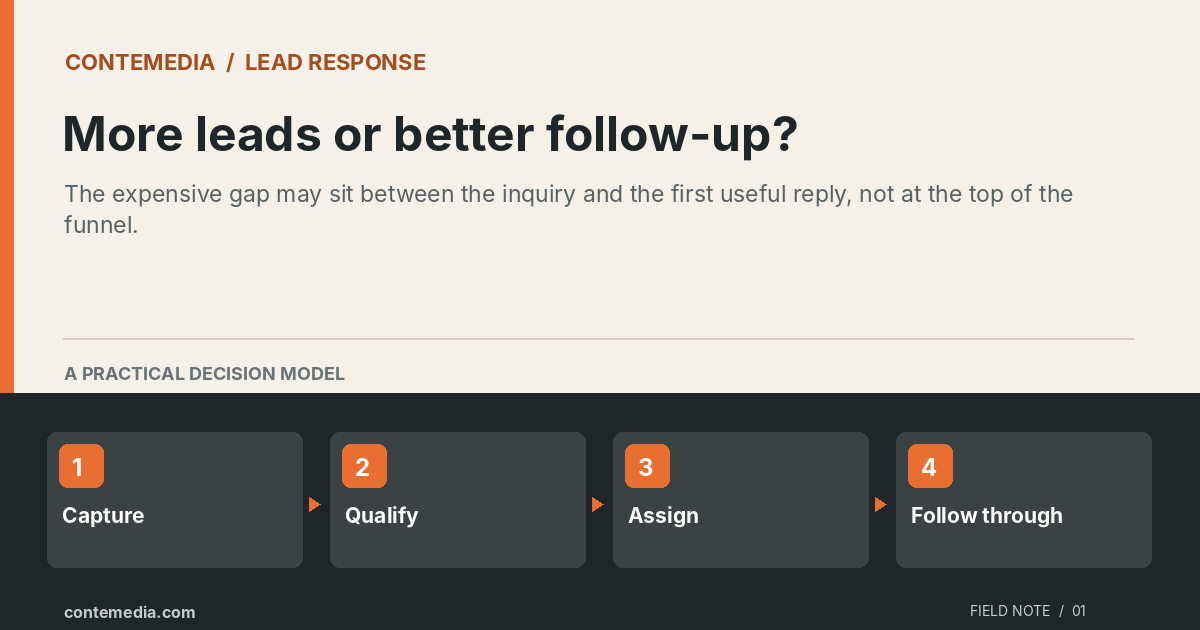
More leads or better follow-up?
The expensive gap may sit between the inquiry and the first useful reply, not at the top of the funnel.
What to examine before changing the process
A campaign can generate more forms while sales still misses calls, delays responses, or closes tasks without confirming what happened to the prospect. Review the full path from first contact to qualified outcome before allocating another dollar to lead generation.
Illustrative case: a team receives 120 legitimate inquiries per month. A sample of 30 finds that six had no assigned owner and four received a reply after the buyer had already chosen another provider. That does not prove ten lost sales. It does justify testing whether clear routing and a same-day second attempt improve qualified conversations.
Measure the change, not just the activity
Track qualified inquiries, response time by source, percentage assigned to an owner, contact attempts, appointments or qualified opportunities, and the percentage reaching a documented outcome. Review by source, because a high-volume but low-fit channel can distort the overall story.
Where the interpretation can go wrong
Avoid calling every missed call a lost customer. Existing customers, spam, duplicates, and low-fit inquiries must be separated before calculating an opportunity.
Four checks before committing resources
- 01
Trace source attribution all the way through to the sale. A form submission that exists in marketing software but never enters the CRM is a different problem from a lead that arrives correctly and waits for an answer.
- 02
Match timestamps across the call system, web forms, email inbox and sales records. Watch for duplicate contacts and inquiries that bypass a common intake queue. Use a small reconciled sample to determine how much demand is actually unowned.
- 03
Set distinct response expectations for urgent sales requests, routine follow-ups and existing customers. A generic instant auto-reply is not a conversation, and an aggressive target that sales cannot sustain will look good on paper but fail the customer.
- 04
Test whether a single owner and explicit second attempt improve qualified conversations. Review the results by lead source, not by total raw inquiries. If the problem is poor-fit demand rather than missed contact, the marketing strategy needs to change instead.