
CONTEMEDIA / PRACTICAL FIELD GUIDE
Before an agent is given a tool, someone must decide which actions it can take without asking.
Control design is part of the business case, not an afterthought for the technical team.
A practical, editable companion. Start with your own records, then compare the evidence with the guidance below.
of surveyed firms already using AI named accuracy, bias or misinformation as a challenge.
The Federal Reserve figure applies to current AI users in an optional survey module. It does not measure AI agent failure rates. Read the original source.
Start with permissions
List every system the agent can see. Separate read access, drafting, record updates and external actions. Least-privilege access reduces the damage an incorrect instruction or compromised account could cause.
Create an approval matrix
A tool that suggests a refund can be useful. A tool that independently approves a large refund may be unacceptable. Identify dollar thresholds, sensitive data, customer communications and legal commitments that always require human approval.
Test beyond ideal examples
Include missing order numbers, conflicting records, unusual language, duplicate customer requests and deliberate attempts to make the agent ignore its instructions. Capture what the agent did, not only whether the final answer sounded plausible.
Build an operator handoff
The person receiving a failed or uncertain case needs the original request, attempted steps, supporting records and an appropriate next action. Do not ask employees to reconstruct the context from scratch.
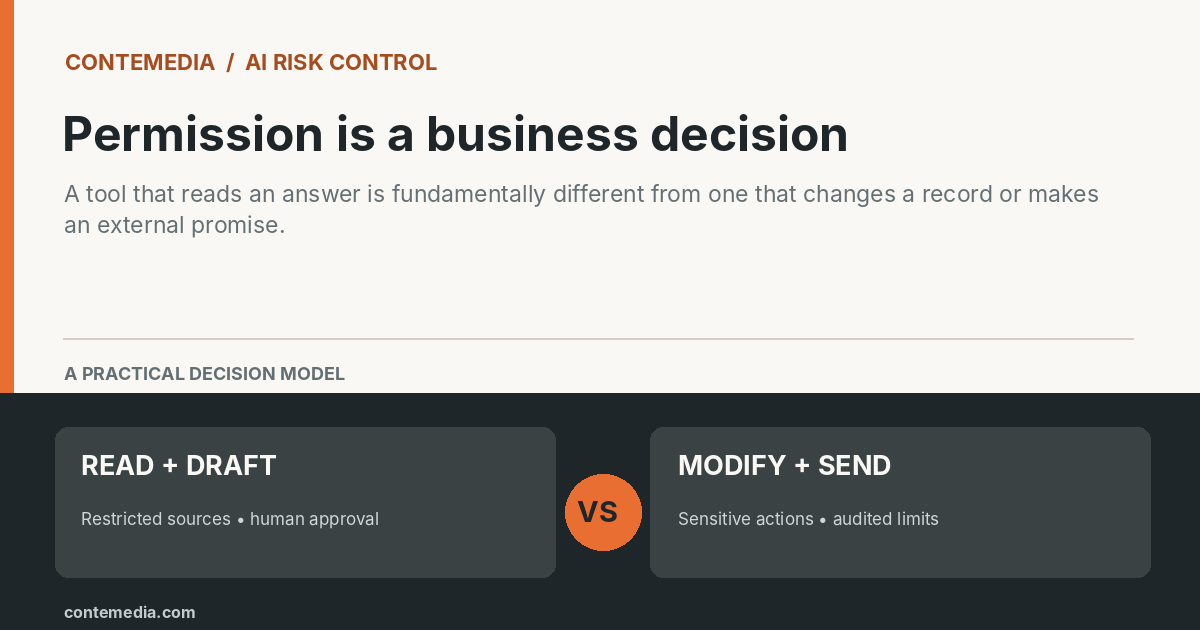
Permission is a business decision
A tool that reads an answer is fundamentally different from one that changes a record or makes an external promise.
What to examine before changing the process
Assign risk based on the data, action and potential cost of a mistake. Sensitive customer or financial information requires stricter boundaries. A supervisor should be able to reconstruct who authorized the action, what source was consulted, and what happened when the result was uncertain.
Illustrative case: an agent may retrieve an invoice status, but it cannot approve credits above or change bank details. Ambiguous requests create a draft for a named employee rather than a completed transaction. This is a control design example, not a universal permission threshold.
Measure the change, not just the activity
Monitor unauthorized-action attempts, escalations, staff overrides, error severity, source conflicts, and time required to inspect a failure.
Where the interpretation can go wrong
A successful demo with clean input is inadequate. Test conflicting records, inaccessible systems, misleading requests and attempts to bypass instructions.
Four checks before committing resources
- 01
Classify each possible tool action as read, propose, modify or communicate. Record the information sensitivity and business consequence, rather than describing permissions only as “access granted.”
- 02
Require approval for actions that alter money, legal commitments, sensitive records or customer promises. The approval owner and maximum permitted scope should be visible in configuration and test evidence.
- 03
Test whether a seemingly valid user instruction can cause the system to reveal protected records or ignore a workflow control. Review the input, attempted action, denied permission and operator message together.
- 04
Keep an audit trail that can answer what the agent saw, decided, attempted and actually completed. Retention, privacy and security requirements should be reviewed for the real systems involved.
Compare the approaches
| Approach or step | What to consider |
|---|---|
| Read public FAQs | Lower exposure if the source is controlled |
| Update internal records | Requires access boundaries and change logs |
| Send customer messages | Requires approved content, review and opt-outs where applicable |
| Move money or accept terms | Keep with authorized personnel |
Controls to approve before a pilot
- Name the business owner of the agent.
- Classify every connected source by confidentiality.
- Test at least five adversarial or ambiguous cases.
- Define when to stop, escalate or request consent.
- Review logs and quality before expanding authority.
Frequently asked questions
Is agent monitoring a technical task only?
No. The business owner must define acceptable customer experience, costs and failure consequences.
Is logging enough?
No. Logs help only when someone reviews exceptions and has authority to correct the process.
Download field-ready worksheets
Use these downloadable, formatted Excel worksheets to capture observations and assign follow-up. They are templates, not data collected or stored by Contemedia.
Download the branded nine-tab Excel field kit, or explore the individual worksheets in our resource library.
External data and additional reading
Federal Reserve Small Business Credit Survey, 2026: Original source and methodology. Figures describe the source population and date, not Contemedia client results. Decisions and illustrative calculations must be validated with your own information.